Never think about
tax at checkout.
Every sale produces a document that stands up, every return properly reverses it, and any order you send to the UK or the EU carries the right tax for where it lands.
Included in every plan. Not an add-on, not a premium tier.
US sales tax and nexus are not worked out yet. The order is still recorded and the invoice is still issued.
sales tax only becomes visible when it has already gone wrong.
Two of these bite whether or not your own state’s sales tax is in the picture, and the third is the one that catches US sellers the first time they ship abroad.
The invoice does not stand up
A business customer needs a document with the right details on it before it goes anywhere near their books. If yours is wrong, you get the email — usually months later.
Your overseas customer got stopped at the border
A parcel held for an unexpected charge is a refund, a bad review and a customer who does not order again. Rarely your fault. Always your problem.
A return was never properly reversed
A refund that does not produce a matching credit note leaves two records telling different stories, and the difference surfaces at the worst possible time.
The deadline arrives with nothing ready
The date never moves, so the work compresses into the same panicked stretch every period — reconciling exports from systems that were never designed to agree.
What is handled, and what is not.
Being straight about this is more useful than a page of coverage claims. Here is exactly where the tax engine acts on your orders and where it stands aside.
An invoice, issued as it happens
Carrying your branding and the details a business customer needs. Once sent it is never quietly edited — a correction is a credit note, the way it should be.
Orders you send to the UK or the EU
Those regimes are live. The destination rate goes on at checkout, the parcel clears, and your customer is not asked for more money at the door.
A credit note that properly reverses
Linked to the original, so the two always tell the same story. Nothing is rewritten after the fact, which is exactly what an auditor wants to see.
US sales tax and nexus
We do not calculate these and we are not going to pretend otherwise. Everything else — the shop, the catalogue, the stock, the orders, the shipping and the reporting — works today.
What is live, and what is not.
Tax software that overstates its coverage is worse than none, because you only discover the gap at a deadline. So here is the plain version.

United States
Sales tax and nexus are not worked out yet. Orders you send to the UK or the EU are, at their rate.
United Kingdom
Domestic VAT applied at checkout, on the invoice, and rolled into the return you file.
European Union
Sell into all 27 member states at the destination rate, and report it on a single return rather than 27.
India — GST
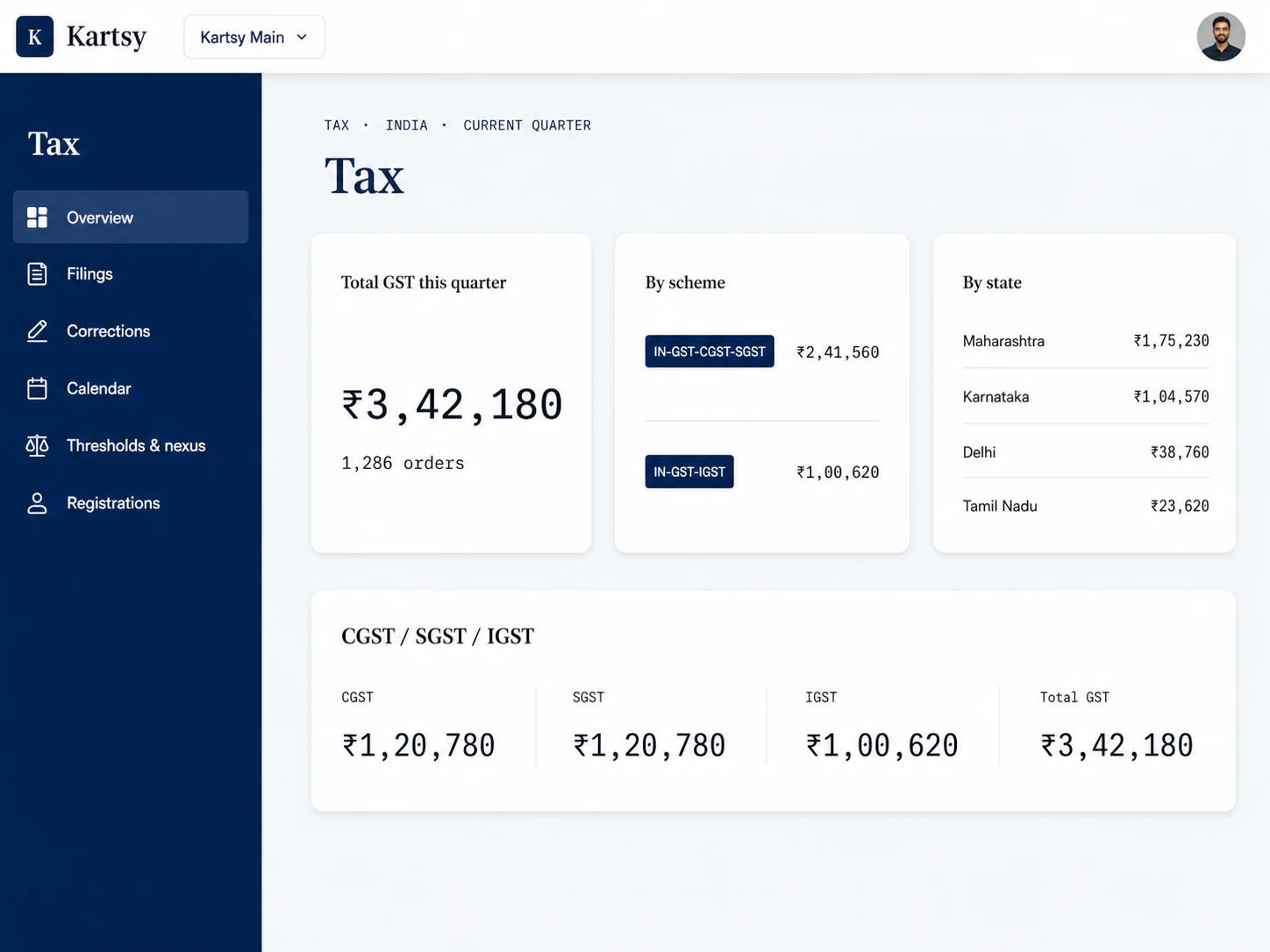
Place of supply decides the split: CGST and SGST inside your state, IGST across it, at the slab the product’s HSN code carries.
Selling somewhere not listed? Everything else — shop, catalogue, stock, orders, shipping and reporting — works anywhere. Tell us where you sell.
Documents that fall out of the sale.
Because the tax is settled as the order is placed, the invoice is simply a record of a decision already made — not a document somebody assembles later from a spreadsheet and hopes is right.
An invoice for every sale
Issued automatically, carrying your branding and the details a business customer needs to claim anything back.
A credit note for every return
Properly reverses what was charged and links back to the original, so the two always tell the same story.
Period figures that already agree
Sales, refunds and the tax on anything you shipped abroad add up as you go, so period end is a read rather than a rebuild.
- Producing invoices by hand, or fixing ones that were wrong
- Chasing down which refund matched which sale
- Looking up the rate for a country you have never shipped to
- Explaining a surprise customs charge to an angry customer
- Re-doing all of it when goods come back
- Reconciling three exports that were never designed to agree
That list is the actual product. Everything else on this page is how we get there.
Getting this right is the job, not a feature of it.
Tax is the part of the platform where being approximately right is the same as being wrong, so it is built and tested to a different standard than the rest.
Decided while the sale happens
The amount is worked out when the order is placed — not reconstructed from a report weeks later, when the money has already been banked and spent.
Every figure has a history
You can look at any order and see what was charged and on what basis. If a figure is ever questioned, the answer exists rather than being reconstructed from memory.
A return is a correction, not an edit
When goods come back you get a credit note that properly reverses the original. Nothing is quietly rewritten after the fact, which is exactly what an auditor wants to see.
Rules change without you noticing
Rates move and thresholds get revised. Keeping up with that is our job, and it happens in the background — you do not get a migration or a release note.
One thing we will not pretend: Kartsy is software, not your accountant. It does the arithmetic, the paperwork and the preparation faithfully — but it does not replace professional advice on how your particular business should be registered or structured.
Put a test order through and see the tax land.
Send one at home, one to a customer in the UK, and one to a business in the EU. Watch what is worked out, what is not, and the invoice that comes out either way — before you move a single real sale across.